Rob Salvino
Product Strategy | Enterprise Software | AI & Data Products
I thrive in the product manager role working in the middle between customers and developers to build ideas that add real value.My work spans enterprise software, AI-powered forecasting, energy analytics, and digital experience design. Across every project, I start by observing how people work, identifying where they struggle, and designing products that solve meaningful problems.
Selected Work
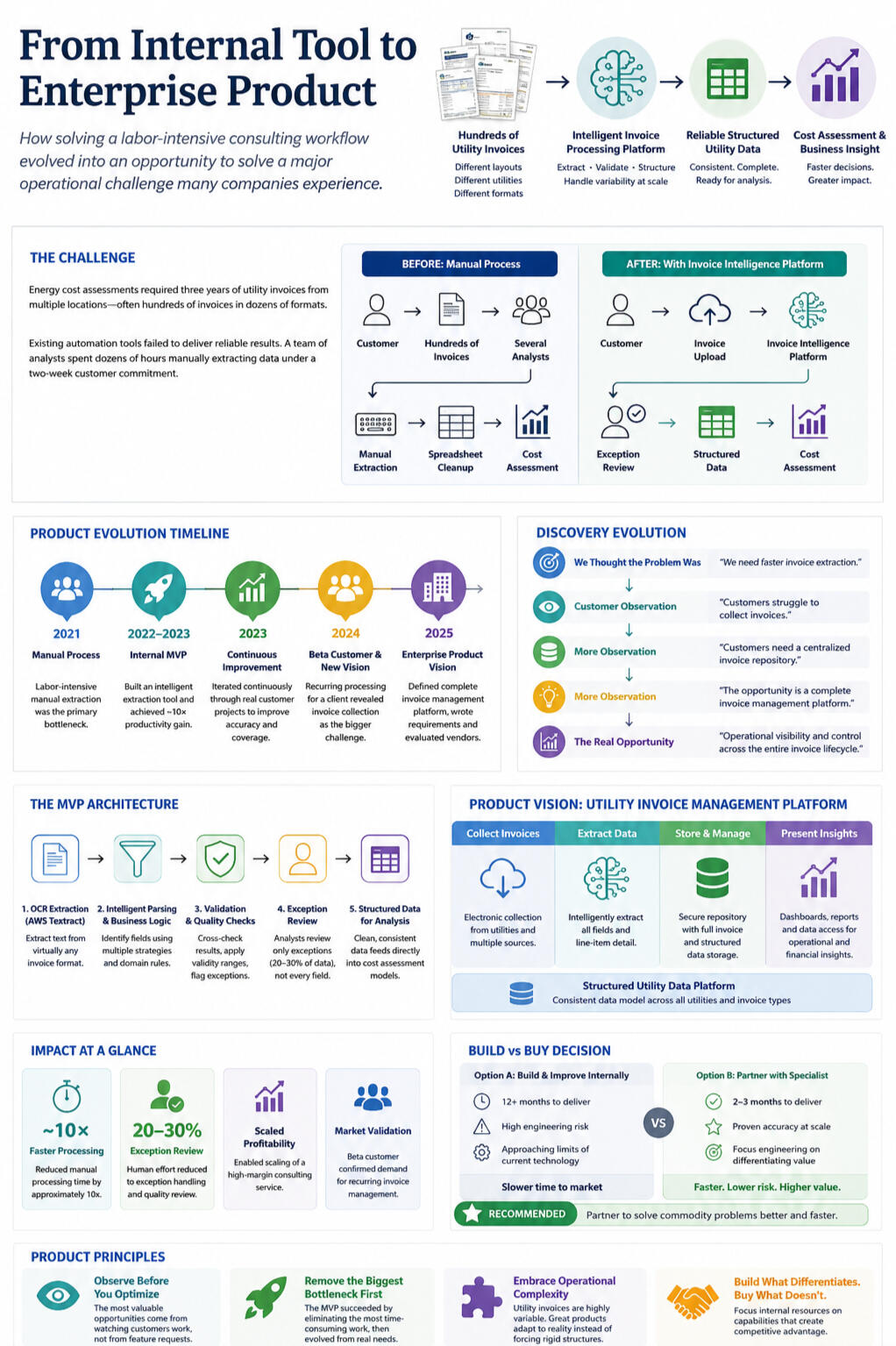
Case Study 1: Utility Invoice Intelligence
Role: Product Strategy • Customer Discovery • AI Workflow Automation • Product Requirements
One of my favorite parts of product management is customer discovery. I tend to take an organic approach to this by keeping an open mind and observing over time. If I am working with a customer, I'll seek to understand their job first, then widen the lens and consider how that job supports the company's objectives. What are the pain points? Are there addressable opportunities?
The product highlighted in the case study really evolved over time as we gained a clearer picture of the scope of the business problem. I started out designing and building a custom data extraction tool for internal usage. In time, I realized the tool could be converted into something that could address a major pain point for larger, geographically dispersed companies--managing the utility invoice process.
Yet, several obstacles stood in the way of a marketable product. We needed a way to automate the invoice collection process, and we needed a higher degree of data accuracy than the internal tool was capable of achieving. After persistent research, I identified a third-party partner that solved both challenges and transformed the opportunity from an internal productivity tool into a scalable customer platform.
I love this case study because customer discovery not only led us to a new platform product, but it also gave us a pathway to convert one-off consulting sales to recurring revenues.
Case Study 2: Building Energy Forecasting
Role: Product Strategy • Machine Learning • Customer Validation • Product Roadmap
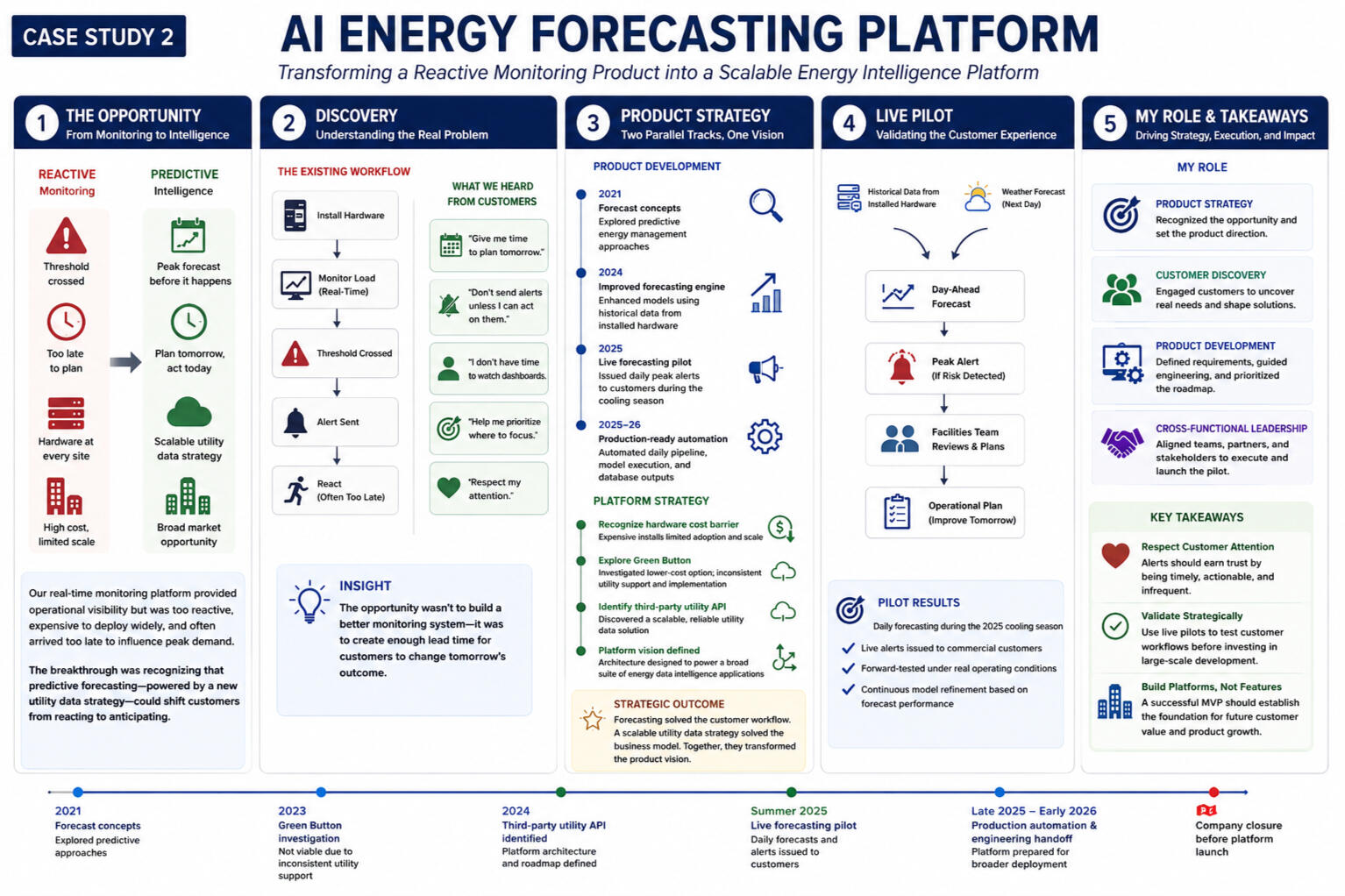
I want the work I do to lead to something meaningful. Over the years I've learned that good ideas rarely fail because they're technically difficult. More often development stalls because projects are asked to do too much (feature bloat) or veer from the customer problem they're trying to solve (poor vision). These issues often negatively impact more than the immediate project at hand. They can impede the company's overall development capacity. I am all about keeping things simple, staying focused, and clearing the path ahead.
For the project highlighted in this case study, I realized early on that we could improve our SaaS platform by adding a machine learned-based forecast. Although the forecasting technology itself was achievable, the broader product opportunity was not yet obvious, so engineering resources were directed elsewhere.
Rather than waiting, I continued advancing the opportunity on two fronts. I independently developed and validated the forecasting models while also interviewing customers to better understand their workflows and the broader market. When I identified a third-party utility meter data provider, I realized the product could expand far beyond our existing hardware-based solution, making it accessible to a much larger customer base. I re-framed the opportunity around market expansion rather than feature enhancement, secured buy-in, and was able to move quickly because the forecasting engine had already been validated.
Case Study 3: Crafting the Story of a Beloved Seattle Park
Role: Product Design • Information Architecture • User Experience • Content Strategy
Domain doesn’t matter to me. Really. I’ve worked in lots of different spaces. Actually, I thrive on that—learning something new, having to overcome the challenges of solving problems I’ve never seen before, learning how to use new tools. Oftentimes it’s when I do my best work—bringing a new perspective can lead me to an insight that others may have overlooked.
When I first began volunteering in Seattle's parks, a longtime volunteer told me that one of the area's forests once held a tree nearly 400 feet tall. I was skeptical—it would have rivaled the tallest trees ever recorded—but curiosity got the better of me. After digging into the history, I discovered there was truth behind the story. It was my first lesson that parks often have remarkable stories hidden just beneath the surface.
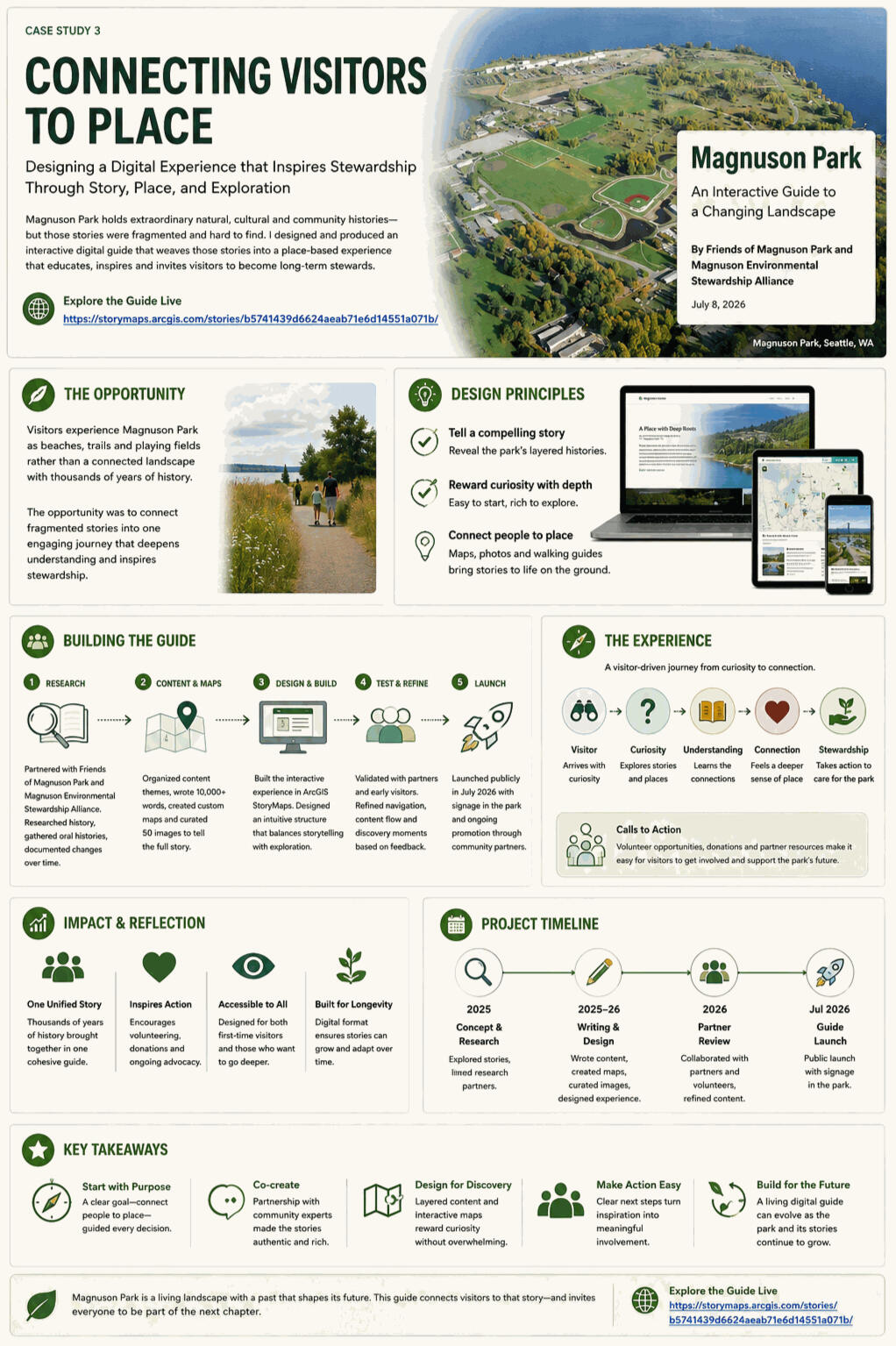
Years later, as a volunteer leader at Magnuson Park, I realized I was having that same experience all over again. Although I visited the park regularly, I kept discovering layers of natural, cultural, and community history I had never encountered. Many of the volunteers I worked with—even longtime park users—shared the same blind spots. I saw an opportunity to create something that would help visitors better understand the park, enrich their experience, and ultimately inspire a deeper sense of stewardship.
After extensive research including many conversations with other park advocates, the result is an online park guide, a digital experience for park users that illustrates the cultural and natural history of the land that the park sits on.
At more than 10,000 words, 50 photographs, and six interactive maps, the guide is intentionally comprehensive. To keep it approachable, I organized it into four standalone chapters, allowing visitors to explore topics in any order. I built the guide in ArcGIS StoryMaps to combine narrative, photography, and interactive maps into a dynamic digital experience—one that I believe is far better suited than static kiosks to telling the story of place.
I believe we've created a model that other large urban parks could adapt to help visitors better understand and connect with the places they steward. Looking back, I think our success came in part from approaching the challenge as a product and user experience problem rather than simply an information problem.
Contact Me
I'm always interested in discussing product management, AI-enabled software, energy analytics, tall trees, habitat restoration, and opportunities to build products that solve meaningful problems.